Can IBS Cause Nausea? 8 Facts Doctors Want You to Know
Have you ever had one of those days where your stomach just feels completely out of whack? Maybe it cramps, maybe you have to run to the bathroom, or maybe nothing is moving at all. If that happens a lot, doctors often call it IBS, which stands for Irritable Bowel Syndrome.
Most of the time, when people talk about IBS, they talk about bathroom habits – like diarrhea, constipation, or a lot of bloating and gas. But if you have IBS, you might have noticed another really annoying feeling: nausea, or that “I think I might throw up” feeling in your throat and chest.
So, can IBS actually cause nausea? The short answer is yes. Even though nausea isn’t one of the main things doctors look for when they diagnose IBS, tons of people who have it say they feel sick to their stomach, especially when their IBS is acting up.
In this article, we are going to dive into the science behind why this happens. You’ll learn exactly why your gut and your brain might be playing tricks on you, what triggers that awful green-around-the-gills feeling, and most importantly, simple tricks you can use to make the nausea go away. Let’s get into it!
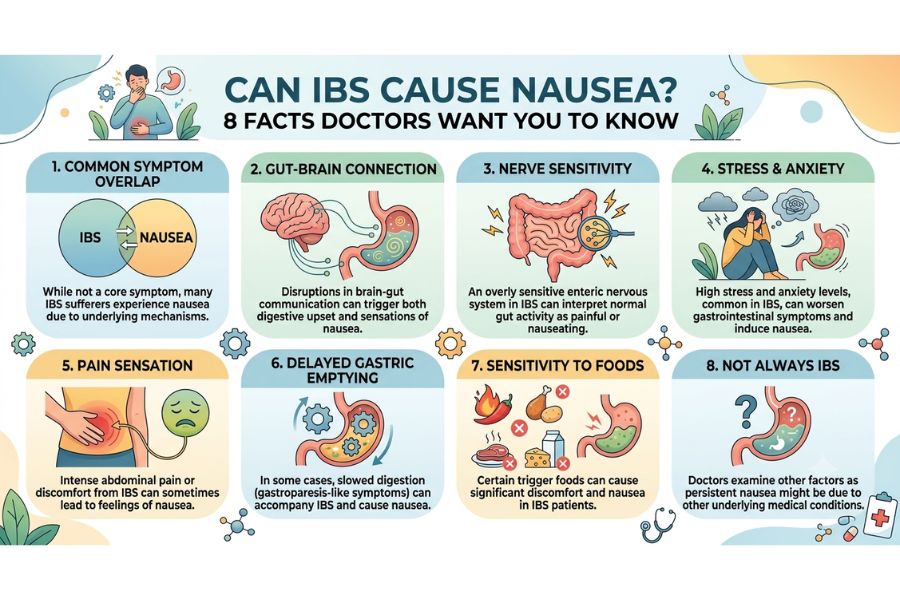
Here are the 8 facts
Understanding how your body works makes it much easier to see why an irritated gut can suddenly turn into a full-blown wave of nausea.
When you look at the actual mechanics of IBS, the trouble usually boils down to eight key realities about how your digestive system, your nervous system, and your daily habits interact.
By breaking these down, you can pinpoint exactly why your stomach is reacting this way and, more importantly, figure out how to finally make that green feeling go away.
Fact # 1. The Gut-Brain Connection Can Trigger Nausea
How the Gut and Brain Communicate
I always tell people that your brain and your gut are constantly talking to each other like they are holding two-way walkie-talkies.
They share a massive network of nerves that sends messages back and forth every single second. When your brain gets stressed, your gut feels it, and when your gut is upset, your brain gets the memo instantly.
Why IBS Can Affect More Than Digestion
Because this connection is so strong, IBS is never just a bathroom problem. When your intestines get irritated, the bad vibes don’t stay in one place.
They travel right up that nerve highway, which is why a gut issue can easily spill over and make your whole body feel exhausted, stressed, or totally sick to your stomach.
The Role of the Nervous System in Nausea
Your nervous system acts like the volume knob for your body. For those of us with IBS, that volume knob is turned up way too high.
When your gut nerves become super sensitive, they can accidentally send a panic signal to the brain that flips on your body’s nausea switch, even if your actual stomach hasn’t done anything wrong.
Fact # 2. IBS Flare-Ups Can Make Nausea Worse
I like to think of an IBS flare-up as a sudden thunderstorm inside your belly. Most days your digestion might feel relatively calm, but during a flare-up, everything gets extra angry, irritated, and sensitive all at once.
When that storm hits, you usually have to deal with sharp cramps and heavy bloating. I want you to imagine a balloon inflating inside your belly and pressing right up against your stomach.
That intense physical pressure, combined with the sharp pain of the cramps, overloads your body’s sensors and naturally triggers a wave of nausea.
If you are wondering if your nausea is actually caused by your IBS, I always tell people to look for a clear pattern.
If that sick-to-your-stomach feeling shows up at the exact same time your belly starts hurting, or if the nausea suddenly fades away right after you finally use the bathroom, you can be sure it is tied to your IBS flare-up.
Fact # 3. Certain Trigger Foods Can Increase IBS-Related Nausea
When I talk to people dealing with this, the conversation always turns to food. It makes total sense, but the connection between what you eat and feeling nauseous with IBS goes a lot deeper than just having a temporary upset stomach.
Think about the last time you ate something super greasy, like a big basket of french fries or a heavy slice of cheesy pizza. For a normal gut, breaking down heavy, fatty, or super spicy food is already a tough workout.
But when you have IBS, your digestive system is already exhausted. Throwing a heavy meal at it is like asking someone who just ran a marathon to immediately lift heavy weights. Your stomach essentially panics and slows down to a crawl.
Also Read: 25 Foods That Cause Gas and Bloating
When food just sits there because your upper digestive system is overworked, it creates a traffic backup that makes you feel completely green around the gills.
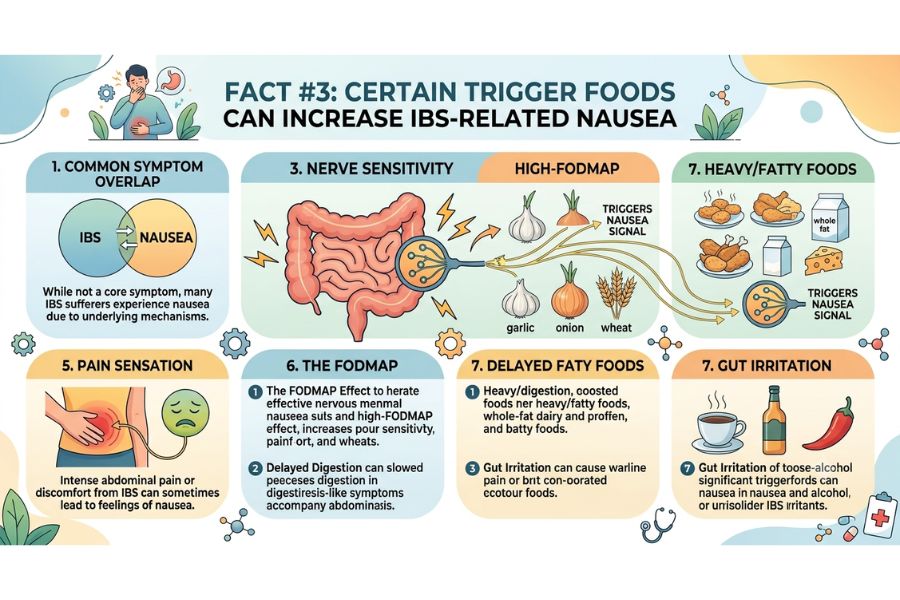
Then there is a specific group of troublemakers that scientists call FODMAPs. That is just a fancy, scientific name for certain types of sugars found in totally normal, everyday foods—things like apples, onions, garlic, and even milk.
For a lot of us with sensitive bellies, our bodies can’t absorb these sugars properly. Instead of digesting quietly, they sit in your gut and ferment, which is just a scientific way of saying they create a massive amount of trapped gas.
I want you to picture a balloon slowly inflating inside your lower belly. As that gas expands, it takes up so much room that it physically pushes upward against your stomach.
That constant, tight pressure squishing your stomach from underneath is a huge reason why you suddenly feel like you want to throw up, even if you only ate a few bites of food.
Because everyone’s gut reacts to different things, I always tell people that you have to become a bit of a health detective.
The easiest way to do this is by keeping a simple food and symptom journal. You don’t need anything fancy—just a little notebook where you write down what you ate and how your body felt a few hours later.
When I have people do this, they almost always start seeing patterns they never noticed before. You might realize that garlic makes you feel sick every single time, but spicy food is actually fine.
Once you know your personal triggers, you can plan your meals with real intent, keeping your belly happy and completely skipping that awful nausea.
Fact # 4. IBS Medications May Contribute to Nausea
It can be incredibly frustrating when the very things we take to feel better end up making us feel worse, but I see this happen all the time with IBS medications.
When you are trying to calm down an angry gut, your doctor might suggest different options like fiber supplements, laxatives to get things moving, or pills designed to slow down diarrhea.
While these treatments are trying their best to help, they can easily cause a bit of accidental trouble in your system.
Also Read: Constipated After Taking Probiotics?
For example, if you take a medicine to stop your gut from moving too fast, it can sometimes do its job a little too well. It slows your intestines down so much that it creates a temporary plumbing backup.
When things are stuck at the bottom of the pipe, your upper stomach can’t empty itself out properly, leaving you feeling incredibly sick to your stomach. Other times, certain pills can just irritate the sensitive lining of your stomach as they dissolve, triggering nausea as a direct side effect.
The most important thing I want you to remember is that you never have to just sit there and suffer through these side effects.
If you notice that a specific wave of nausea always hits right after you take your IBS medicine, or if the sick feeling doesn’t go away after a week or two, it is a clear sign that something needs to change.
I always encourage my readers to schedule a quick chat with their doctor. Doctors expect these kinds of setbacks, and they can easily adjust your dose or switch you to a gentler alternative so you can get the gut relief you need without the stomach-churning side effects.
Fact # 5. Stress and Anxiety Can Intensify Nausea
Have you ever felt “butterflies” in your stomach right before a big test, a public speech, or a stressful event? That is the perfect everyday example of how your emotions can instantly change how your stomach feels.
When I look at the relationship between stress and IBS, it is incredibly clear that they are deeply tied together. Your brain and your belly are constantly gossiping with each other, meaning that when your mind gets overwhelmed, your gut usually pays the price.
How Anxiety Affects Digestion
To understand why anxiety makes you feel sick, we have to look at what happens inside your body when you get worried. When you feel anxious or panicked, your brain automatically goes into what doctors call “fight or flight” mode.
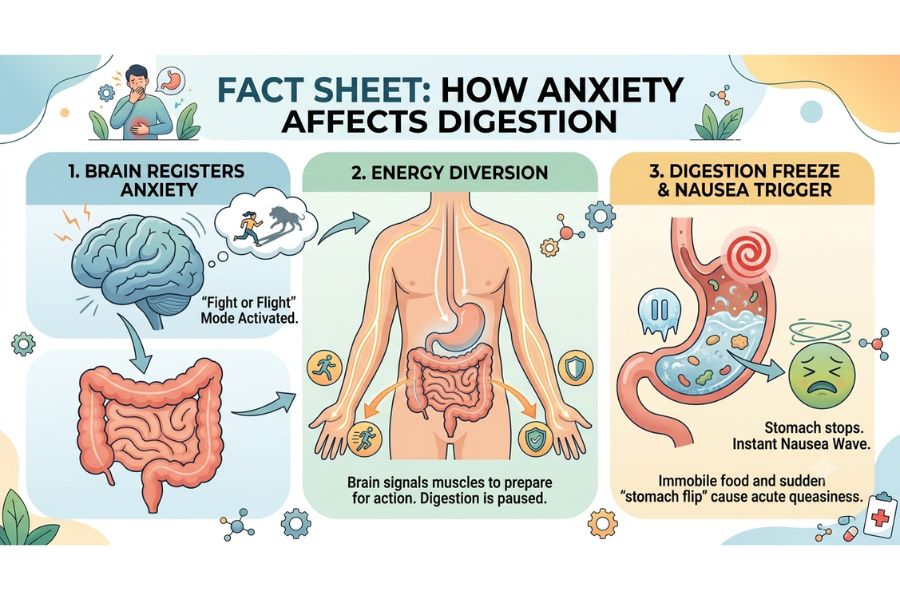
I like to think of this as your body’s ancient survival system. Your brain thinks you are in danger – like you are being chased by a wild animal – so it shifts all of its energy away from digesting food and sends it to your arms and legs so you can run away or protect yourself.
Because your body suddenly hits the pause button on your digestive system, any food you recently ate just stops moving. This sudden freeze in digestion can make your stomach flip and instantly trigger a strong wave of nausea.
Practical Ways to Manage Stress-Related Symptoms
The good news is that because your brain has the power to turn on this physical reaction, you can also use your mind to turn it off.
When I talk to people dealing with stress-related nausea, I always suggest simple, practical ways to calm the nervous system down without needing anything fancy.
One of my favorite tricks is deep belly breathing. When you take slow, deep breaths, it physically forces your heart rate to slow down and signals to your brain that you are completely safe.
Once your brain realizes there is no emergency, it turns your digestion back on, relaxing your gut nerves and causing that sick-to-your-stomach feeling to fade away.
Fact # 6. Delayed Digestion and Gut Sensitivity May Cause Nausea
Another major reason you might be feeling green comes down to a combination of slow digestion and a concept doctors call visceral hypersensitivity. That is a massive, complicated medical term, but I like to explain it simply as having a gut with the internal volume knob turned up way too high.
How IBS Affects Digestive Function
In a typical digestive system, your stomach breaks down food and moves it along down the pipeline at a steady, quiet pace. But when you have IBS, your entire digestive function can easily get out of sync.
For many people, IBS actually causes the stomach to go into slow-motion. Instead of mashing up your food and passing it along to your intestines, your stomach holds onto it for much longer than it is supposed to.
When food just lingers in your upper stomach instead of moving down the line, it creates a physical backup that naturally makes you feel like you need to throw up.
Visceral Hypersensitivity Explained
On top of things moving slowly, those super-sensitive belly nerves mean your gut feels every single movement with intense detail.
In a normal gut, your intestines stretch and move gas around completely in the background, and your brain never even notices it.
But when you have IBS, your nerves are so sensitive that a tiny, normal amount of trapped gas or digestion pressure feels like a major emergency to your nervous system.
Why Some People Feel Nauseous After Eating
In my experience, this hyper-sensitivity is exactly why so many people with IBS complain about feeling nauseous almost immediately after taking a few bites of food.
When you eat a meal, your stomach naturally has to stretch out a little bit to make room for what you swallowed.
To an IBS gut, that gentle, normal stretching triggers a panic response. Your over-sensitive nerves misinterpret the feeling of a full stomach as a threat and send an immediate danger signal straight to your brain, which flips on your body’s nausea switch before you’ve even finished your plate.
Fact # 7. Nausea May Be a Sign of an Overlapping Digestive Condition
Sometimes, I find that IBS gets blamed for everything happening in your belly, but it actually doesn’t like to travel alone.
It is incredibly common for your gut to deal with more than one issue at the exact same time. If your nausea is sticking around and feeling extra intense, it might be a sign that another digestive condition is crashing the party.
IBS vs GERD
One of the most frequent tag-team partners for IBS is GERD, which is just a fancy medical short-form for chronic acid reflux. I like to think of your stomach like a blender with a secure lid at the top. In a normal body, that lid stays tightly shut.
But when you have GERD, the lid loosens, allowing harsh stomach acid to splash back up into your throat. This causes a nasty, burning chest pain, and that constant bubbling of acid right under your throat can easily make you feel incredibly sick to your stomach.
IBS vs Gastroparesis
Another condition that looks a lot like IBS but treats your stomach a bit differently is gastroparesis. Earlier, I mentioned that IBS can sometimes make your digestion run in slow-motion.
Well, gastroparesis takes that to a whole new level – it essentially means your stomach muscles are partially paralyzed. Instead of gently squeezing and pushing food down into your intestines, your stomach just sits completely still.
When food lingers there for hours and hours, it starts to spoil and trigger severe, long-lasting nausea and vomiting that feels much heavier than normal IBS.
IBS vs Food Intolerances
I also always tell people to watch out for sneaky food intolerances, like struggling to process dairy or gluten. This is different from just having a sensitive stomach; it means your body lacks the specific tools to break down certain ingredients.
When you accidentally eat something your body can’t handle, your immune system and your gut throw a massive protest. This leads to instant, painful bloating, cramping, and a wave of nausea as your body tries to figure out how to get rid of the food.
Why an Accurate Diagnosis Matters
This is exactly why I always tell my readers that getting a proper diagnosis from a doctor is so important. You can’t fix a problem if you are using the wrong map to find it.
If you are treating your body only for IBS, but the real troublemaker is actually acid reflux or a dairy intolerance, you will keep feeling sick.
Sitting down with a doctor to figure out the exact combination of what is happening inside your belly means you get the right plan to finally make the nausea stop.
Fact # 8. Lifestyle Changes Can Help Reduce IBS-Related Nausea
The absolute best part about figuring out how your gut works is that you don’t have to just sit around and accept feeling green all the time.
I have found that making a few simple, gentle shifts in your daily routine can completely change how your stomach behaves and drastically cut down on that nauseous feeling.
Dietary Adjustments
When your stomach is feeling super sensitive, I always suggest going back to the basics with your food. I like to focus on eating gentle, plain items that don’t force your stomach to work too hard – things like oatmeal, simple rice, or baked chicken.
I also highly recommend inviting ginger and peppermint into your kitchen. For centuries, people have used ginger tea or peppermint capsules because they act like a natural relaxation massage for your stomach muscles, calming down the twitching that makes you feel sick.
Hydration and Meal Timing
How and when you consume things matters just as much as what you eat. If you try to eat three massive, heavy meals a day, you are going to overload your sensitive stomach and trigger that slow-motion backup we talked about. Instead, I find it works much better to eat five or six tiny meals spread throughout the day so your stomach never gets too full.
When it comes to drinking water, I tell people to sip it slowly all day long. If you chug a giant glass of freezing cold water all at once, it instantly stretches your stomach out and can flip on that sensitive nausea switch.
Physical Activity and Symptom Management
When you feel like you want to throw up, your instinct is probably to curl up into a ball on the couch. While that feels cozy, it actually squishes your stomach and makes digestion even harder.
I always encourage people to try taking a gentle, slow walk around the block after eating. Gentle movement uses gravity to help pull food down the pipeline naturally, and it also releases happy chemicals in your brain that turn down the volume on your gut’s pain signals.
Sleep and Recovery
Finally, never underestimate the power of a good night’s sleep. When you are asleep, your body goes into a deep repair mode, fixing tired cells and calming down your nervous system.
If you consistently miss out on sleep, your body gets stressed, which instantly cranks up your brain-gut sensitivity.
By making sure you get plenty of rest and give your body time to recover, you keep your stress levels low, your nerve highway quiet, and your stomach feeling calm and happy.
When Nausea Signals Another Condition
While it is incredibly relieving to know that IBS can be the root cause of your nausea, I always want to make sure we are playing it safe.
IBS is definitely uncomfortable and annoying, but it isn’t a dangerous condition. However, because different stomach issues can look a lot alike, we have to keep an eye out for warning signs that tell us your body might be dealing with something completely different.
I like to think of your body like a car dashboard. If a little light pops up saying you are low on windshield wiper fluid, you don’t panic.
But if the engine oil light starts flashing bright red, you know you need to pull over immediately. In the medical world, doctors call these major warning lights “red flags.”
They are symptoms that simply don’t belong to normal IBS, and if you notice them popping up alongside your nausea, it means it is time to see a doctor right away.
One major red flag is when your nausea becomes severe and constant. Normal IBS nausea usually comes and goes—maybe it hits right after you eat a heavy meal or when you are feeling super stressed out during a flare-up.
But if you have an intense, sick-to-your-stomach feeling that hangs around day after day without ever giving you a break, that is a sign that something else is going on. If you can’t even keep a glass of water down, or if the nausea is so bad that you stop eating entirely for a few days, you shouldn’t just wait it out.
It could mean your body is fighting off a nasty bug or dealing with a blockage in your digestive tract.
Another thing to watch out for is actual vomiting, a high fever, or dropping weight without trying. I always remind people that IBS is a functional problem, which means your gut parts look totally healthy under a microscope, they just aren’t cooperating smoothly.
Because of that, IBS on its own almost never makes you actually throw up. If your nausea turns into frequent vomiting, if you run a fever, or if you notice that your clothes are suddenly fitting much looser even though you haven’t changed your diet, your body is waving a giant warning flag that it needs a doctor’s help.
The biggest red flags of all are finding blood when you use the bathroom, or experiencing severe stomach pain that literally wakes you up from a deep sleep in the middle of the night.
IBS can cause a lot of cramping, but it never causes bleeding or disrupts your sleep with sudden, sharp pain. If you see blood in the toilet, or if your stomach pain is stealing your rest, you need to contact a healthcare professional immediately.
It might feel a little scary, but checking in with a doctor is the absolute best way to stay safe, get the right answers, and finally get your stomach back on track.
Putting It All Together
Dealing with a grumpy stomach is never fun, and adding nausea to the mix makes it even tougher. But if there is one thing I want you to take away from our chat today, it is that you are definitely not crazy – IBS can absolutely make you feel sick to your stomach.
Whether it is because of your brain and gut gossiping over their nerve walkie-talkies, trapped gas pressing upward like a balloon, or your stomach digesting in slow-motion, that nauseous feeling is a very real response to an irritated digestive system.
While it is completely normal for a wave of nausea to pop up when your IBS is flaring, I always remind people to listen closely to what their body is saying.
If your nausea becomes severe, hangs around day after day without a break, or brings along red flags like vomiting or a fever, please don’t just try to tough it out. Your body is smart, and constant, heavy symptoms are its way of telling you it is time to get a doctor’s evaluation just to make sure nothing else is hiding in the background.
For your everyday IBS nausea, remember that you have so much power to turn things around and help your stomach feel happy again.
I highly encourage you to start playing health detective by tracking your personal food triggers in a little notebook, sipping your water slowly, and practicing deep belly breathing to calm your nervous system.
Most importantly, remember that you don’t have to figure this out all on your own. Work closely with a trusted healthcare professional who can help you safely navigate your symptoms.
Together, you can build a gentle, smart plan that settles your gut, banishes that green feeling, and gets you back to enjoying your life!